

In the realm of screen-free parenting, where the emphasis lies on fostering creativity and limiting digital exposure, the introduction of Critikid has sparked intriguing discussions in our household. As a devoted advocate of screen-free principles, I have always prioritized hands-on learning experiences for my now 9-year-old child. However, recognizing the evolving landscape and my daughter’s burgeoning curiosity about screens, I’ve cautiously introduced the concept of critical thinking through Critikid. This online platform offers a unique opportunity for children to develop essential thinking skills while navigating the digital realm. Approaching it with a mindful perspective, I’ve embraced the chance to guide my child through this educational journey, exploring screens as tools for learning and growth under my vigilant supervision. This blog post delves into this carefully curated screen-related activity, shedding light on how Critikid aligns with my commitment to balanced and thoughtful parenting in our increasingly digital age. I’ve also interviewed both Adèle and Stephanie Simoes, the creator of Critikid to give you a more in-depth look into the course.
***Disclaimer: This post contains affiliate links, and if you decide to purchase anything from suggested links or companies, I may receive a commission. Recommended products are either things I love using or think would be helpful for you. Making your purchase using these affiliate links helps keep this site running, so thank you kindly!

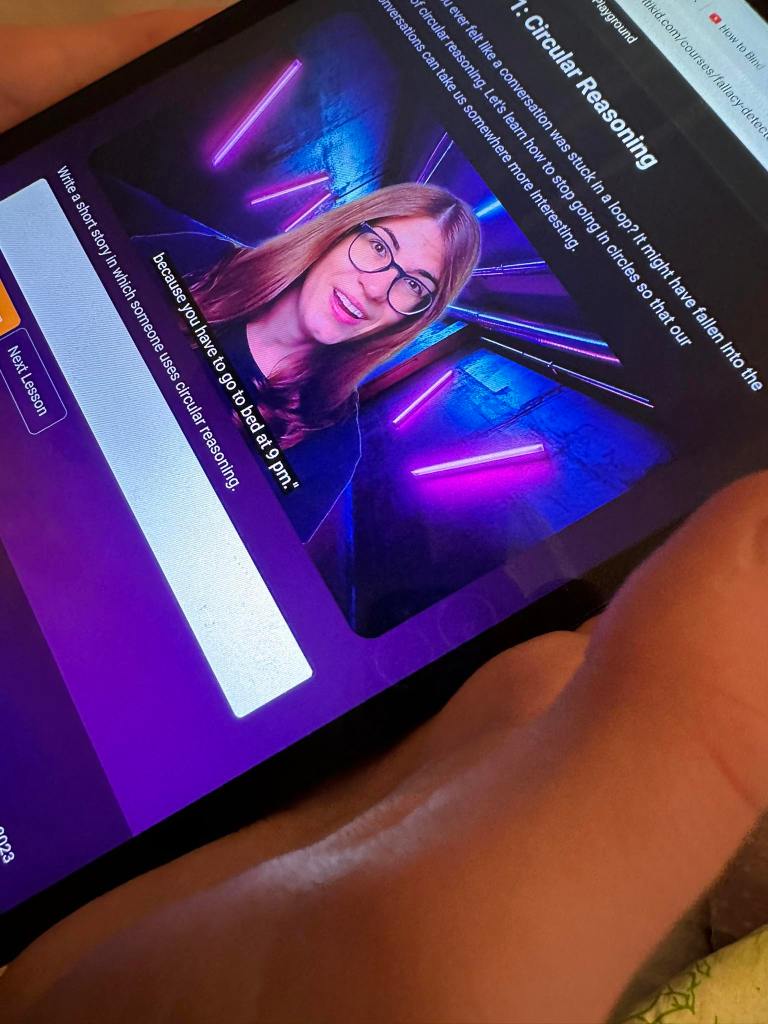
First of all, I want to thank Stephanie who was kind enough to allow Adèle to try out her course. She followed the entire Fallacy Detector Part 1 and immediately asked to do the other classes as well. As she only had access to the first one, Adèle asked to review the material the following day and then we had a very long discussion about what she learned over dinner. Here is a little snippet of our conversation:
What do you think about Critikid?
Adèle: “It’s interesting.”
What did you learn?
Adèle: “Well, I learned about different types of fallacies which help me to identify them when having a conversation. I’ve been able to identify LOADS of circular reasoning!”
Can you give me an example?
“Why do I have to eat the ratatouille when I don’t like it?”
Because you have to.
Adèle: “CIRCULAR REASONING ALERT!”

Would you recommend it to other kids?
Adèle: “Yeah! You learn loads of stuff.”
How do you feel about it being in a digital / online format?
Adèle: “I find it easier to follow like this than if it was in person because you are actually looking at a video of how it works and it’s clear. And, if you were to do it with someone like them teaching you about it. If you didn’t understand it, they’d have to repeat it loads of times and they might not want to do that or might not even be able to do it. So, with the digital format, you can just rewind the video, and if you don’t understand it the first time you can watch it as many times as you want.”
And here is what Stephanie shared about herself and Critikid:
Can you briefly describe who you are?
My name is Stephanie Simoes. I’m a science teacher and children’s educational video creator. My educational background is in science and philosophy. People always thought this was a strange combination, but what both fields have in common is that they are trying to figure out how the universe works!
What are the biggest struggles you have overcome?
Critikid is my first startup, so I’ve had to learn a lot of new skills. I have experience in education and video creation, but I’ve recently had to become a marketing director and social media manager, too! It’s tough and I’m still learning, but I recognize that these are valuable skills that will serve me in any future projects I undertake if I can master them.
How did you come up with the idea for Critikid?
The lack of critical thinking in the online world is apparent to anyone who spends any time in the comments section in social media. Logical fallacies abound. Moreover, misinformation is getting harder to detect.
Unfortunately, there aren’t a whole lot of critical thinking resources available for children. You can find some books about logical fallacies, but I still haven’t come across any thorough online, video-based resources. With more and more parents and teachers utilizing online learning, I decided that a website with videos and interactive activities would be a good way to teach kids what is becoming a more and more vital skill.
What specific skills can it teach kids?
The course that is currently available, Fallacy Detectors Part 1, teaches kids about how to spot and respond to logical fallacies – in other words, bad arguments. If all goes well, I will introduce courses about cognitive biases (systematic errors in thinking) and formal logic next.
What is a good age to introduce it to children?
Fallacy Detectors is targeted to kids ages 9-12. The future courses about cognitive biases and formal logic will be meant for older students.
How can kids use these skills in real life?
Logical fallacies are all over the place, and they tend to derail conversations. When we can recognize them, we are better able to get conversations back on track. Learning about logical fallacies makes kids better communicators.
Learning about cognitive biases means learning about our minds. When we understand cognitive biases, it makes us better decision-makers because it helps us to understand why we make the decisions we do.
How do you approach/handle mistakes?
As I am currently learning many new skills, many mistakes are inevitable right now. However, I know that when we try to learn a new skill, making mistakes is not normal but necessary because it helps us learn. Failure and frustration can change our brain in a good way!
Could you recommend your favourite books on the topic?
For logical fallacies, I like “An Illustrated Book of Bad Arguments” by Ali Almossawi because it has creative pictures, great examples, and thorough explanations. The language is too advanced for young children, but parents and teachers may find it useful.

What is your wish/goal with Critikid?
After completing the courses on logical fallacies, cognitive biases, and formal logic, I’d like to create a “social media simulator”, a highly-moderated forum where children can put their critical thinking skills to use as they debate hot topics in a respectful and rational way.
The Internet is a battlefield full of biases, bad arguments, and polarization, and kids are going to face it sooner or later. Critical thinking their armour. My goal is to help kids forge it.
Can you provide a quote that encapsulates your feelings?
“What we want is to see the child in pursuit of knowledge, and not knowledge in pursuit of the child.” – George Bernard Shaw
I like this quote because I believe that it is important to nurture a child’s natural sense of curiosity and let them discover things for themselves whenever possible. Critical thinking is a tool that can help them to do this.


Stephanie has generously offered a discount to the readers of my blog!
Discount code (15% off Fallacy Detectors): SUNNY15
Link to course: https://critikid.com/courses/fallacy-detectors-1
 Creative Parenting